




Introduction
If you've just been told you have a kidney stone, your first question is probably: "Does this mean I need surgery?" The answer depends largely on one critical factor — the size of the stone. Kidney stone size is the single most important determinant of whether a stone will pass on its own, respond to medication, or require a medical procedure.
Yet most patients walk out of a scan room with a number — "4mm," "8mm," "14mm" — and no clear explanation of what it actually means for their treatment. This blog breaks it all down with a clear, easy-to-understand kidney stone size chart, so you know exactly where you stand and what to expect.
Why Size Matters More Than You Think
Kidney stones form when minerals and salts crystallise inside the kidneys. They can vary dramatically in size — from a tiny grain of sand to a large staghorn stone that fills the entire kidney. Size directly affects:
- Whether the stone can pass naturally through the urinary tract
- How much pain does it cause as it moves through the ureter
- Which treatment option is most appropriate
- How urgently is medical intervention needed
Size alone, however, is not the only factor. The location of the stone, its shape and composition, and the patient's overall health also play important roles in treatment decisions. That said, size remains the primary guide.
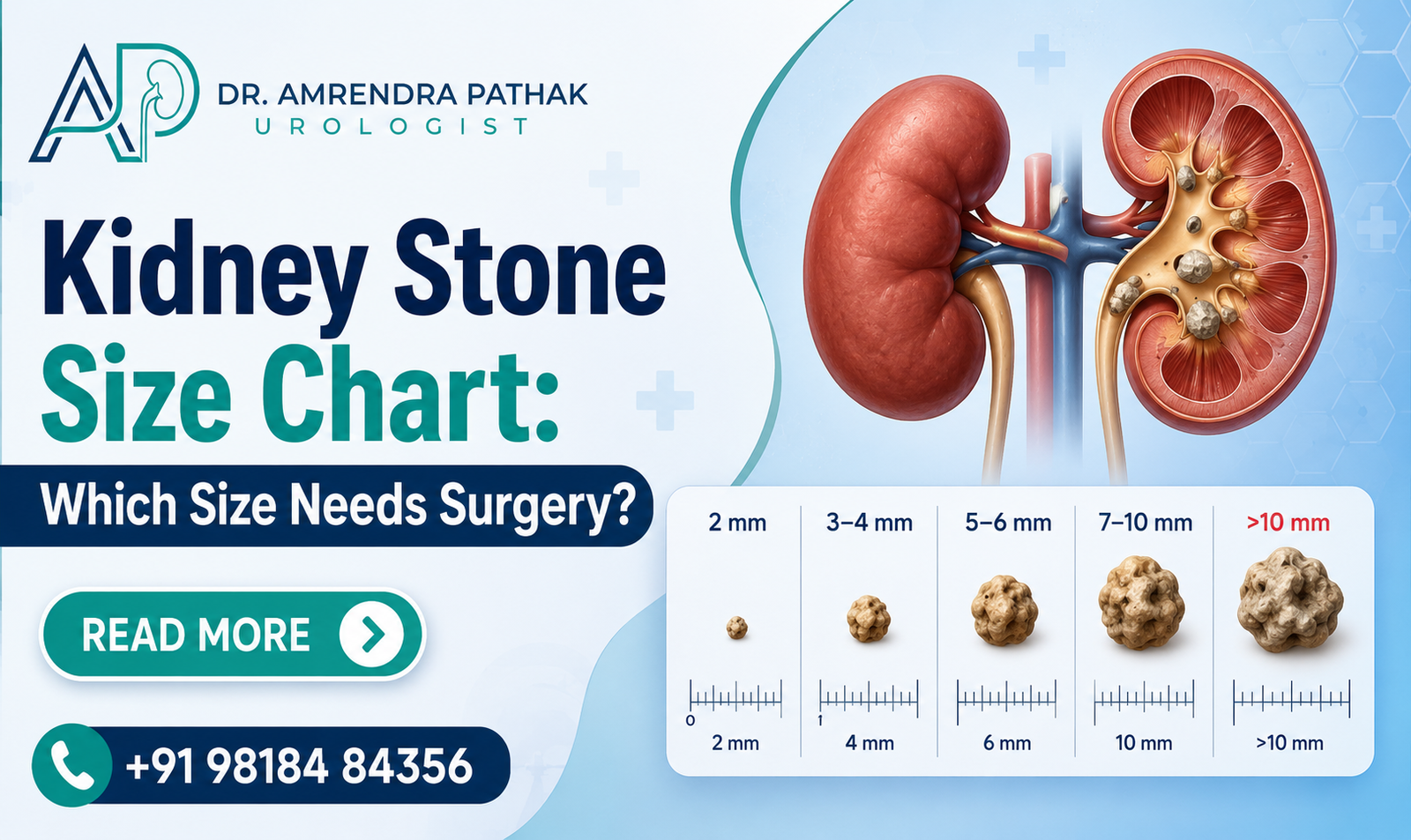
Kidney Stone Size Chart: A Complete Breakdown
Less Than 4mm — High Chance of Passing Naturally
Stones smaller than 4mm have an approximately 80–98% chance of passing on their own without requiring surgical intervention. These are the smallest stones and typically travel through the ureter with minimal complication.
What to expect:
- Increased fluid intake (2.5–3 litres per day)
- Pain relief medication (NSAIDs or prescribed analgesics)
- Alpha-blockers (like tamsulosin) to relax the ureter and aid passage
- Regular monitoring through ultrasound or X-ray
Timeline: Most stones in this category pass within 1–2 weeks.
Surgery needed? Rarely. Watchful waiting is the standard approach.
4mm to 6mm — Moderate Chance of Passing
Stones in this range have a 60–80% chance of passing naturally, but they require closer monitoring and medical support. Some may pass with alpha-blocker therapy; others may get stuck in the ureter and cause complications.
What to expect:
- Medical expulsive therapy (alpha-blockers + hydration)
- Pain management
- Regular follow-up scans every 1–2 weeks
- If the stone fails to pass within 4–6 weeks, intervention is considered
Surgery needed? Sometimes. If the stone causes persistent pain, infection, or doesn't move within the expected window, a procedure may be recommended.
6mm to 10mm — Intervention Usually Required
Stones above 6mm have a significantly reduced natural passage rate — approximately 20–47%. Many stones in this range become lodged in the ureter, blocking the flow of urine and leading to hydronephrosis (swelling of the kidney) and an increased risk of infection.
Recommended procedures:
Extracorporeal Shock Wave Lithotripsy (ESWL) Sound waves are directed at the stone from outside the body to break it into smaller fragments that can then pass through urine. Best suited for stones in the kidney or upper ureter, typically up to 10mm.
Ureteroscopy with Laser Lithotripsy (URS) A thin, flexible scope is passed through the urethra to reach the stone. A laser breaks the stone into fine dust or small passable fragments. Highly effective for ureteric stones in the 6–10mm range. No incisions required.
Surgery needed? Yes, in most cases. The best kidney stone treatment in Old Rajendra Nagar for this size range typically involves ESWL or laser ureteroscopy, depending on stone location and composition.
10mm to 20mm — Surgery Is Strongly Recommended
Stones larger than 10mm have a very low probability of passing naturally and almost always require active treatment. At this size, the risk of urinary obstruction, kidney damage, and infection is significant.
Recommended procedures:
Retrograde Intrarenal Surgery (RIRS) An advanced flexible ureteroscope navigates into the kidney itself to access and laser-fragment stones located within the renal pelvis. Suitable for stones up to 15–20mm.
Percutaneous Nephrolithotomy (PCNL) is a minimally invasive procedure where a small puncture is made in the back to directly access and remove the stone using a nephroscope. This is the gold standard for stones in the 10–20mm range located within the kidney.
Surgery needed? Yes. Prompt intervention is necessary to protect kidney function. Consulting the best urologist in Old Rajendra Nagar ensures you receive the most appropriate, least invasive procedure for your specific stone.
Greater Than 20mm — Staghorn Stones, Urgent Care Needed
Stones larger than 20mm — including the infamous staghorn calculi that branch into multiple parts of the kidney — are complex cases requiring comprehensive surgical planning.
Recommended procedures:
PCNL (often in multiple sessions). Large staghorn stones may require more than one PCNL session to achieve complete stone clearance. In some cases, a combination of PCNL and ESWL is used.
Open Surgery Though rare today, open surgery may be considered in exceptionally complex cases where minimally invasive approaches are not feasible.
Surgery needed? Absolutely. Delays in treatment can lead to chronic kidney infection, permanent kidney damage, and even kidney failure. Seek urgent evaluation from a specialist.
Quick Reference: Kidney Stone Size Chart
|
Stone Size |
Natural Passage Rate |
Recommended Treatment |
|
< 4mm |
80–98% |
Watchful waiting, hydration, and medication |
|
4mm – 6mm |
60–80% |
Medical expulsive therapy, monitoring |
|
6mm – 10mm |
20–47% |
ESWL or Laser Ureteroscopy (URS) |
|
10mm – 20mm |
Very low |
RIRS or PCNL |
|
> 20mm |
Near zero |
PCNL (multiple sessions) or open surgery |
Other Factors That Influence Treatment
While size is the primary guide, your urologist will also consider:
- Stone location: Upper, middle, or lower ureter; within the kidney
- Stone composition: Uric acid stones may dissolve with medication; calcium oxalate stones cannot
- Degree of obstruction: Is urine flow significantly blocked?
- Kidney function: Is the affected kidney still functioning adequately?
- Presence of infection: A stone with an associated urinary infection (pyonephrosis) is a urological emergency
- Patient's overall health: Age, body weight, and coexisting conditions affect procedure choice
When to Seek Immediate Medical Care
Do not wait if you experience:
- Fever above 101°F alongside flank pain — this indicates a possible kidney infection
- Complete inability to urinate — may signal a total urinary blockage
- Severe, uncontrollable pain not relieved by medication
- Nausea and vomiting are preventing oral fluid intake
- Blood in urine combined with a high temperature
These are urological emergencies. Patients across Delhi seeking the best kidney stone treatment in Old Rajendra Nagar should head to a specialist immediately if any of these symptoms are present — delayed care can result in permanent kidney damage.
Frequently Asked Questions (FAQs)
Q1. Can a 7mm kidney stone pass on its own?
It's possible but unlikely — most 7mm stones require ESWL or laser ureteroscopy to be cleared safely.
Q2. What is the maximum stone size that ESWL can treat?
ESWL is generally effective for stones up to 10mm; larger stones typically need PCNL or RIRS.
Q3. How long does it take to pass a 4mm kidney stone?
Most 4mm stones pass within 1–2 weeks with adequate hydration and medication support.
Q4. Is PCNL a major surgery?
No — PCNL is minimally invasive, requiring only a small back puncture, with most patients discharged within 2–3 days.
Q5. Where can I get the best treatment for kidney stones in Delhi?
Consult the best urologist in Old Rajendra Nagar for advanced, personalised kidney stone treatment using the latest minimally invasive techniques.
Conclusion
Understanding your kidney stone's size is the first and most empowering step toward getting the right treatment. Stones under 4mm will often pass on their own with time and hydration. Stones between 4 and 10mm may need medical assistance. Stones above 10mm almost always require a procedure — and the larger the stone, the more urgent the need.
The good news is that modern urology offers safe, effective, and minimally invasive solutions for every stone size. You don't have to suffer through pain or fear complications. With the right specialist, the right diagnosis, and the right treatment plan, kidney stones are highly manageable — at any size.
If you're unsure about your stone or haven't received a clear treatment plan, reach out for the best kidney stone treatment in Old Rajendra Nagar today. Early evaluation protects your kidneys and gets you on the fastest path to recovery.