




Introduction
If you or someone you love has been diagnosed with benign prostatic hyperplasia (BPH) — an enlarged prostate — and surgery has been recommended, you've almost certainly encountered two names: TURP and laser surgery. Both treat the same problem. Both are performed without any external incision. And yet they differ significantly in how they work, how long you stay in the hospital, how quickly you recover, and what complications you risk.
Here's an honest, evidence-based comparison to help you understand what each procedure involves — and what the latest research actually says about recovery.
What Is BPH and Why Does It Need Surgery?
The prostate gland surrounds the urethra (the tube carrying urine out of the body) just below the bladder. As men age, the prostate commonly enlarges — a condition called BPH. When the enlarged tissue squeezes the urethra, it causes lower urinary tract symptoms (LUTS): a weak urine stream, frequent or urgent urination, incomplete bladder emptying, interrupted flow, and nighttime trips to the bathroom.
When medications fail to provide adequate relief, surgery becomes necessary. The goal of both TURP and laser surgery is the same: to remove or destroy the obstructing prostate tissue to restore normal urine flow. How they achieve that goal, however, is quite different.
TURP: The Traditional Gold Standard
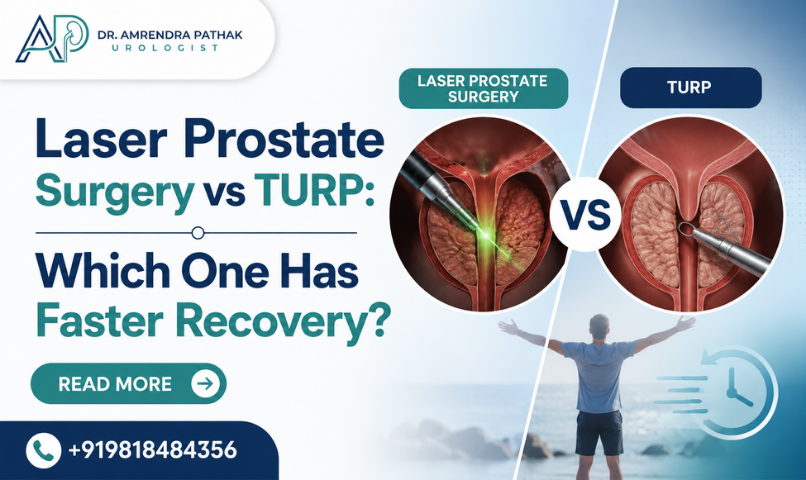
Transurethral Resection of the Prostate (TURP) has been the benchmark surgical treatment for BPH for decades. A thin resectoscope — a tube with a light, camera, and wire loop — is passed through the urethra. The wire loop, heated by electrical current, cuts away sections of excess prostate tissue. The tissue is flushed out and collected for histological analysis (which also allows for incidental cancer detection).
What to Expect with TURP
- Hospital stay: Typically 1–3 days
- Catheter duration: 3–7 days post-surgery
- Return to normal activity: 4–6 weeks
- Blood loss: Moderate to significant; blood transfusion is required in roughly 2–3% of cases
- Long-term effectiveness: Well-established; decades of outcome data confirm durable symptom relief
TURP remains widely available, extensively practised, and comparatively less expensive than laser alternatives. Its main drawbacks are the risk of bleeding (particularly in patients on blood thinners), TURP syndrome (a rare but serious complication from fluid absorption), and a longer post-operative recovery period.
Laser Prostate Surgery: The Modern Alternative
Laser surgery for BPH comes in several forms, but the two most commonly performed are:
HoLEP (Holmium Laser Enucleation of the Prostate): A holmium laser is used to enucleate (shell out) the entire obstructing prostate tissue from within, which is then morcellated (ground up) and removed. HoLEP is size-independent — it can treat both small and very large prostates effectively.
GreenLight PVP (Photoselective Vaporisation of the Prostate): A high-powered green-light laser vaporises (evaporates) the excess prostate tissue instantly. Unlike HoLEP, no tissue is retrieved for analysis.
Both laser techniques are performed through the urethra, require no external cuts, and are increasingly preferred over TURP in modern urology centres.
Head-to-Head: Recovery Comparison
This is where laser surgery shows its clearest advantage over TURP.
Catheter Duration
A 2024 study published in Cureus comparing HoLEP and TURP in elderly patients found that HoLEP significantly reduced catheterisation time — an average of 22 hours versus 50 hours for TURP. Shorter catheter time means less discomfort, lower risk of urinary tract infection, and an earlier return to independent urination.
Hospital Stay
The same study found hospital stays were substantially shorter after HoLEP: one day on average versus three days for TURP. For patients with other health conditions — diabetes, cardiac disease, or respiratory issues — minimising hospital time also minimises the risk of hospital-acquired complications.
Blood Loss
This is perhaps the most clinically significant difference. Laser surgery, particularly HoLEP, causes far less bleeding than TURP. Research data from the GRAND study — a large German registry analysis — found blood transfusion rates of 8.8% for TURP compared to just 2.5% for laser enucleation techniques. For patients on anticoagulant medications (blood thinners), this difference is critical — laser surgery is often the only safe surgical option available.
Return to Normal Activities
Recovery from laser prostatectomy typically takes 2–4 weeks, with many patients resuming light activities within days of discharge. TURP recovery tends to take 4–6 weeks, with a longer period of post-operative discomfort, urinary burning, and flow irregularity as the surgical site heals.
Where TURP Still Holds Its Own
Despite laser surgery's recovery advantages, TURP is not obsolete — and for some patients, it remains the better choice.
Wider availability: Not all hospitals and urology centres have laser equipment or surgeons trained in HoLEP, which requires a steep learning curve. TURP is far more universally available across India, including in community hospitals.
Cost: Laser surgery — particularly HoLEP — is significantly more expensive than TURP. For patients without comprehensive health insurance, this can be a decisive factor.
Tissue analysis: TURP retrieves resected tissue for pathological examination, which can occasionally detect unsuspected prostate cancer. GreenLight PVP, which vaporises tissue rather than excising it, does not allow for this.
Reoperation rates: Some studies have noted that TURP carries a lower long-term reoperation rate compared to certain laser techniques in older, multimorbid populations — particularly when less experienced surgeons perform laser procedures during the early part of their learning curve.
Who Is Each Procedure Best Suited For?
TURP is typically preferred for:
- Men with moderate prostate enlargement (30–80 mL)
- Patients not on blood thinners with no significant bleeding risk
- Settings where laser equipment or expertise is unavailable
- Patients for whom cost is a significant constraint
Laser surgery (HoLEP/GreenLight) is typically preferred for:
- Men on anticoagulant or antiplatelet medications
- Very large prostate glands (over 80–100 mL) — HoLEP is size-independent
- Patients with diabetes, cardiac conditions, or other comorbidities where minimising hospital stay is important
- Men who prioritise faster recovery and minimal blood loss
- Younger, otherwise healthy men who want the most durable, long-term result
For men in central Delhi seeking the best prostate surgery in Old Rajendra Nagar, a thorough pre-operative consultation with an experienced urologist will assess prostate size (via ultrasound), symptom severity (IPSS score), PSA levels, urinary flow rate, and your overall health to determine which procedure offers the best outcome for your specific case.
Complications: What the Data Shows
Both procedures carry risks, and understanding them is essential before consenting to surgery.
TURP risks include: bleeding requiring transfusion, TURP syndrome (fluid absorption into the bloodstream), urinary tract infection, retrograde ejaculation (in up to 65–90% of cases), urethral stricture, and rarely, urinary incontinence.
Laser surgery risks include: transient urinary incontinence (particularly with HoLEP — studies report rates of 27.8% in the short term, though most resolve within weeks to months), dysuria (burning urination), and in the case of GreenLight PVP, inability to retrieve tissue for pathological analysis.
The key takeaway: laser surgery's short-term complication profile around bleeding is significantly better, but it may involve a higher rate of temporary incontinence — particularly with HoLEP. Discussing these trade-offs in detail with your surgeon is essential.
Questions to Ask Your Urologist Before Surgery
Before deciding between TURP and laser surgery, ask:
- What is my prostate size, and which technique is appropriate for it?
- Am I on any medications that increase bleeding risk?
- What is your personal experience with laser prostatectomy versus TURP?
- Does this facility have HoLEP capability, or only GreenLight?
- What is the realistic recovery timeline for my specific case?
If you're researching the best prostate surgery in Old Rajendra Nagar, look for a urology centre that offers both options — and a surgeon who will give you an honest recommendation based on your anatomy and health history, not just what equipment they have available.
The Verdict: Which Has Faster Recovery?
On the evidence, laser surgery — particularly HoLEP — offers faster recovery than TURP across almost every measurable metric: shorter catheter duration, reduced hospital stay, less blood loss, and a quicker return to normal activity.
However, "faster recovery" is not the only factor that should drive your decision. Prostate size, bleeding risk, surgeon expertise, facility capability, and cost all matter. TURP remains a highly effective, widely available, and well-proven procedure that continues to be the right choice for a significant proportion of patients.
The best outcome comes not from choosing the "newer" technique, but from choosing the right technique for your specific situation — with a skilled surgeon who performs it regularly. For personalised guidance on the best prostate surgery in Old Rajendra Nagar, a detailed urological consultation is the essential first step.
5 Short FAQs
Q1. Is laser prostate surgery painful?
Both procedures are performed under anaesthesia, so there's no pain during surgery. Laser surgery typically causes less post-operative discomfort and a shorter recovery than TURP.
Q2. How long does a catheter stay in after TURP vs laser surgery?
After TURP, a catheter is typically needed for 3–7 days. After HoLEP or GreenLight laser surgery, it's usually removed within 1–2 days.
Q3. Can laser prostate surgery be done if I'm on blood thinners?
Yes — laser surgery, particularly GreenLight PVP, is often preferred for patients on anticoagulants because it causes significantly less bleeding than TURP. Consult your urologist for specific guidance.
Q4. Will either surgery affect sexual function?
Both TURP and laser surgery commonly cause retrograde ejaculation (dry orgasm), where semen goes into the bladder instead of out. Erectile function is usually preserved, but discuss individual risks with your surgeon before the best prostate surgery in Old Rajendra Nagar.
Q5. How soon can I return to work after laser prostate surgery?
Most men return to light desk work within 1–2 weeks after laser surgery. Physical or manual labour typically requires 3–4 weeks off.
This blog is for informational purposes only and does not substitute professional medical advice. Please consult a qualified urologist for diagnosis and a personalised treatment plan.